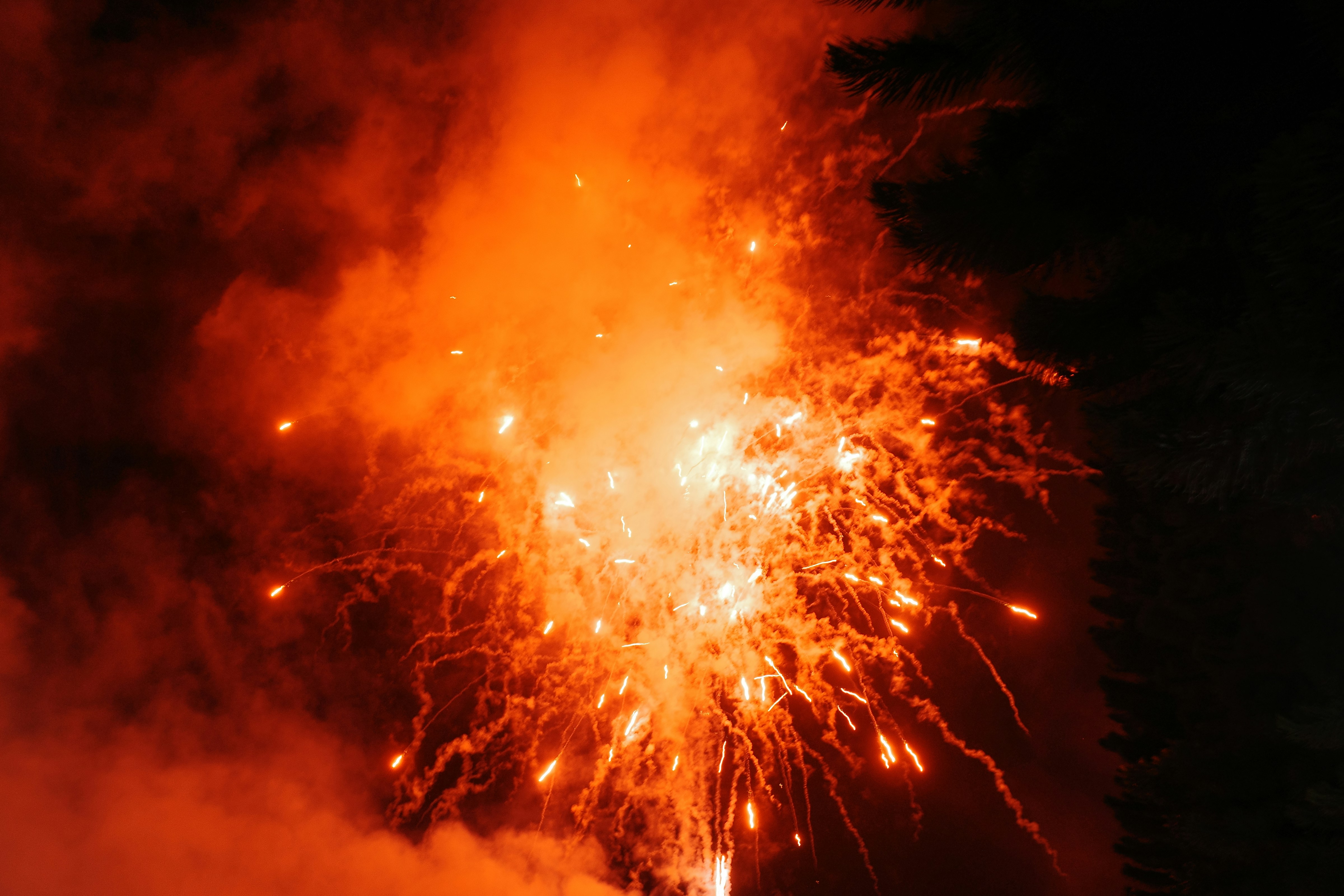
How Do Fireworks Get Their Color? A Buyer's Guide
Key Takeaways
Fireworks get their color from special metal-based ingredients, called metal salts, that burn with specific, bright hues.
Each color comes from a different element: strontium for red, barium for green, and copper for blue.
White and silver sparks aren’t chemical colors at all but glowing metal flakes like aluminum, magnesium, or titanium heated to extreme temperatures.
The answer to the question, “how do fireworks get their color” is a fascinating mix of chemistry and craft, a science that took centuries to perfect. In fact, before the 1800s, every firework was just one color: a yellowish orange. For a breakdown of the evolution of fireworks visit this blog.
But now, you know a good firework when you see one. It's not just loud; it's packed with vivid color, and maybe a few awesome effects.
So, you're probably wondering, how do fireworks get their color? What's the science that unlocked all the variety we see today?
Let's break it down. Understanding the science helps you appreciate the show more, nerd out with your friends, and (most importantly) become a smarter buyer.
So let's get into it!
1. How Do Fireworks Create Light?
The secret behind how fireworks get their color lies in how atoms release energy as light. When a firework burns, two main light processes occur:
Incandescence
This is the most basic form of light. Think of the glowing-hot filament in an old lightbulb or a piece of metal left in a fire. When something gets hot enough, it glows. In fireworks, this "glowing hot" light is what creates the simple, classic white, gold, and silver sparks and tails. This effect usually comes from burning metal flakes like aluminum or titanium.
Luminescence
The second process, luminescence is the real secret to getting those vibrant, saturated colors. When certain elements are heated, their electrons absorb energy and then fall back to their original energy levels, releasing light at precise wavelengths. Each element emits a unique color because each has its own distinct energy structure.
In short, incandescence gives brilliance; luminescence gives hue. Together, they explain how fireworks get their color and why each shade appears so different in the night sky.
2. How Do Those Chemicals Actually Make Color?
So, how does that “chemical light” actually work? Time to put your nerd hat on, because it’s all about what happens inside atoms when fireworks burn: tiny bursts of physics at a microscopic level.
Fireworks contain metal salts that create firework color. Inside every atom of those metal salts are electrons orbiting the atom’s center. In their normal, calm state, those electrons stay close to the nucleus, this is called the ground state.
When a firework explodes, the extreme heat gives those electrons a sudden jolt of energy. That energy pushes them into a higher orbit, farther from the center of the atom. But they can’t stay there for long. Almost immediately, they fall back down, and when they do, they release that extra energy as a tiny particle of light called a photon.
Here's the key: The color of that light particle (the photon) is determined by the exact distance the electron "fell." Since every element has a unique structure, each one gives off its own distinct color when it burns.
3. What Ingredients Make Which Colors?
The vibrant colors in fireworks don't come from dyes or powders. The answer to, “how do fireworks get their color” lies in special ingredients called "metal salts," which determine the quality of the color. Chemists also add "color boosters" (like chlorine) to make the colors pop.
Here is your simple color-by-color guide to what's inside:
Red: Strontium
Green: Barium
Blue: Copper (Hard to make! A deep blue signals a high-quality firework.)
Yellows: Sodium (The same element as in table salt.)
Orange: Calcium
Purple: A mix of Strontium (Red) + Copper (Blue) (Also hard to do well!)
Whites & Silvers: Burning metal flakes like Magnesium, Aluminum, or Titanium
If you want to explore more firework colors, this U.S. government site has photos of the minerals that produce them.
4. How is the Color Packed Inside?
So where are all these chemicals? They're packed into little, rock-hard pellets called "stars."
Each star is basically a tiny, self-contained firework. When the main shell explodes in the air, it lights and scatters thousands of these stars, which is what creates the big burst of color.
A single star is a simple recipe held together with a burnable glue (like dextrin, which is just starch). This recipe contains four key parts: an oxidizer to provide oxygen so it can burn, a fuel to act as the heat source, the colorant (the special metal salt, like strontium for red), and a binder (the "glue") to hold it all together.
So there you have it. The answer to "how do fireworks get their color" isn't magic, it's just really awesome chemistry. You're not just seeing a red burst; you're seeing Strontium releasing its unique atomic fingerprint. You're not just seeing a rare blue; you're seeing a manufacturer who perfectly mastered the heat needed for Copper.
So this year, enjoy your fireworks knowing you've got the insider scoop. At G&C Fireworks we've got all the firework colors and effects you could be looking for. So come see us soon!
FAQs
1. How do fireworks get their color?
They get their color from burning metal compounds that emit specific wavelengths of light when excited by heat.
2. Why are blue fireworks rare?
Blue requires extremely precise temperature control. If the flame is too hot or too cool, the blue color fades or disappears.
3. Are firework colors made with dyes or pigments?
No. The colors come from chemical reactions — not coatings or pigments — that emit light at distinct wavelengths.
4. Why do some fireworks appear white or gold?
Those are created by metals like magnesium or titanium glowing at very high heat, not from color-producing compounds.
5. What’s inside a firework star?
A star contains the ingredients that make color: fuel, oxidizer, colorant, chlorine donor, and binder.
